
Liberty County Criminal Court Records
A criminal court record is the court's case-level file, not just an arrest note or jail row. In Liberty County, the Clerk of Courts is the custodian for Superior, State, Juvenile, and Magistrate records. Once charges are filed into court, the record may include the charging paper, bond orders, arraignment notices, motions, hearing calendars, plea forms, trial entries, sentencing sheets, probation terms, fines, costs, restitution, and final disposition. For charge-only detail after arrest, the separate court charge records path is more focused on the arrest-to-charge stage.
Felony criminal cases route to Superior Court in the Atlantic Judicial Circuit. State Court handles misdemeanors and traffic misdemeanors. Magistrate Court can be the first court touchpoint for arrest warrants, search warrants, preliminary hearings, and bond hearings, so a criminal matter may begin there before moving to Superior or State Court. Juvenile delinquency cases are confidential and should not be treated as ordinary public criminal court records.
The Georgia Superior Courts Liberty County directory identifies the county's Superior Court presence in the Atlantic Judicial Circuit.
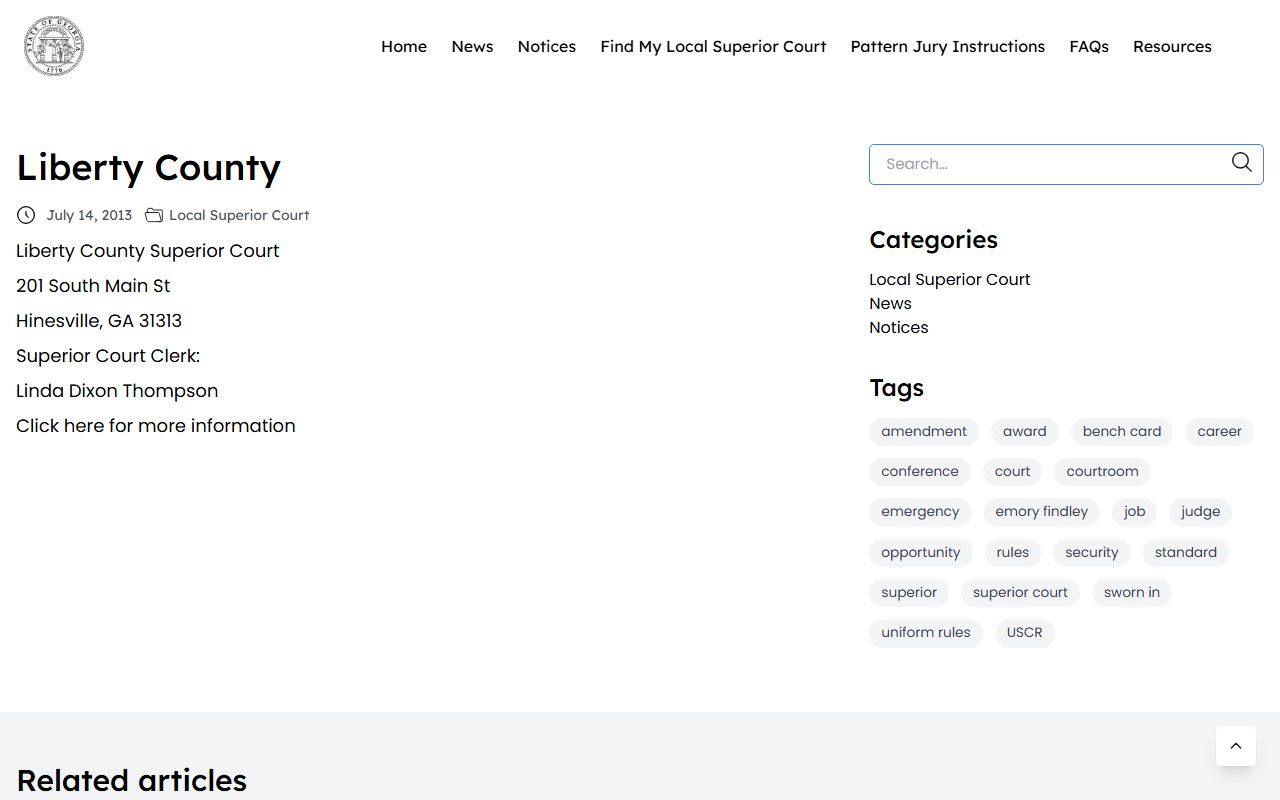
Superior Court is the key felony court, while State and Magistrate Courts explain why some criminal events appear before a final Superior Court disposition.
Search Liberty County Criminal Court Records
Start with Liberty County CM Web Search for public civil and criminal case lookup. The public portal exposes Search By Party, Search By Associated Party, and Search By Case Number tabs. It also has a login path, but ordinary public lookup starts from the visible search modes. The portal disclaimer matters because a public result is not certified proof of disposition. For legal proof, request a certified criminal disposition from the Clerk of Courts.
- Open CM Web Search and choose the search mode that matches the known fact: party, associated party, or case number.
- Search by defendant name when no case number is known. Try alternate spelling only when the official spelling is uncertain.
- Use the case number when the citation, warrant, indictment, accusation, or docket number is available.
- Compare the court and hearing data against the Clerk's court calendars if the goal is date, time, or judge assignment.
- Contact the Clerk of Courts at 912-876-3625 or use eCertification when a certified disposition or document copy is needed.
The Clerk's criminal-history policy is narrower than many users expect. The Clerk does not conduct broad criminal-history searches. Individuals may use public search terminals on site with minimal staff help, and the Clerk can provide copies or certifications for specific criminal dispositions. Statewide criminal-history access uses GBI/GCIC channels rather than a county clerk name search.
Liberty County Criminal Case Process
Criminal court records develop in stages. A charge may first appear through a warrant, arrest, booking, or Magistrate bond event. A misdemeanor can proceed in State Court with the solicitor. A felony usually moves through District Attorney review, grand-jury or charging action, arraignment, plea or motion calendars, trial if needed, and sentencing in Superior Court. Each stage can leave a different record marker.
Case flow: Charges Filed › Arraignment › Pretrial / Motions › Plea or Trial › Disposition › Sentencing
| Stage | What Happens | Record Clue |
|---|---|---|
| Charges filed | A complaint, accusation, indictment, warrant, or related charging entry starts the court case path. | Charge description, statute, count, court, warrant number, or case number. |
| Arraignment | The charge is presented and the defendant enters a plea. | Arraignment calendar, plea entry, defendant name, court, and judge. |
| Pretrial / motions | Parties file motions, set hearings, discuss evidence, and address bond or procedural issues. | Motion calendar, order, hearing notice, or docket entry. |
| Plea or trial | The case resolves by plea, bench trial, jury trial, dismissal, or other court action. | Plea paperwork, verdict, dismissal, nolle prosequi, or judgment entry. |
| Disposition | The court records the outcome of the charge or case. | Certified disposition, judgment, sentence, or final order. |
| Sentencing | The court sets jail, probation, fines, costs, restitution, or other terms where applicable. | Sentence sheet, probation terms, fine and cost entries, restitution order. |
What Liberty County Criminal Records Show
A Liberty County criminal court record can include both case-management facts and substantive court documents. The exact public view depends on the portal, the court, and whether a user is reading a docket, a case file, or a certified copy. The research verified calendar labels, jail charge fields, court roles, copy channels, and public CM Web Search modes. It did not verify a live criminal case detail page, so any online result should be checked against the Clerk when a certified outcome is needed.
| Field | What It Shows |
|---|---|
| Case number | The court's identifier. Related jail records showed warrant or case-like examples, but the CM Web Search criminal format was not fully verified. |
| Defendant | The person charged in the criminal case, distinct from witnesses, victims, attorneys, or associated parties. |
| Court | Superior Court for felonies, State Court for misdemeanors and traffic misdemeanors, or Magistrate Court for warrants, bond, and preliminary events. |
| Charges | The filed accusation, indictment, warrant charge, statute, count, or description, which may later be amended, reduced, dismissed, or resolved. |
| Hearing type | Arraignment, plea and motion, criminal non-jury, bench trial, jury trial, bond, or preliminary hearing. |
| Plea | The defendant's formal answer to a charge, such as guilty, not guilty, or another accepted plea entry. |
| Disposition | The outcome, such as guilty, dismissed, no-billed, not prosecuted, acquitted, or other court result when verified. |
| Sentence | Jail, probation, fines, costs, restitution, and related terms if the case ends in a sentence. |
Liberty County Criminal Court Roles
The Atlantic Judicial Circuit District Attorney prosecutes felony matters for Bryan, Evans, Liberty, Long, McIntosh, and Tattnall counties. The Clerk history material describes the District Attorney as the prosecutor in felony criminal matters and legal advisor to the grand jury. The Liberty County DA directory lists the office at 945 Elma G Miles Parkway in Hinesville with the researched phone number 912-876-4151. State Court misdemeanors and traffic cases are prosecuted by the solicitor, with Chestley Merritt named as solicitor of State Court.
The Atlantic Judicial Circuit District Attorney page is the official source for felony prosecution context in Liberty County criminal court records.

DA review and grand-jury action explain why felony charges may change between arrest, indictment, plea calendars, and final Superior Court disposition.
District Attorney Billy Joe Nelson Jr. took office on January 1, 2023 after election in November 2022. The DA about page gives his circuit background and prosecutorial history.
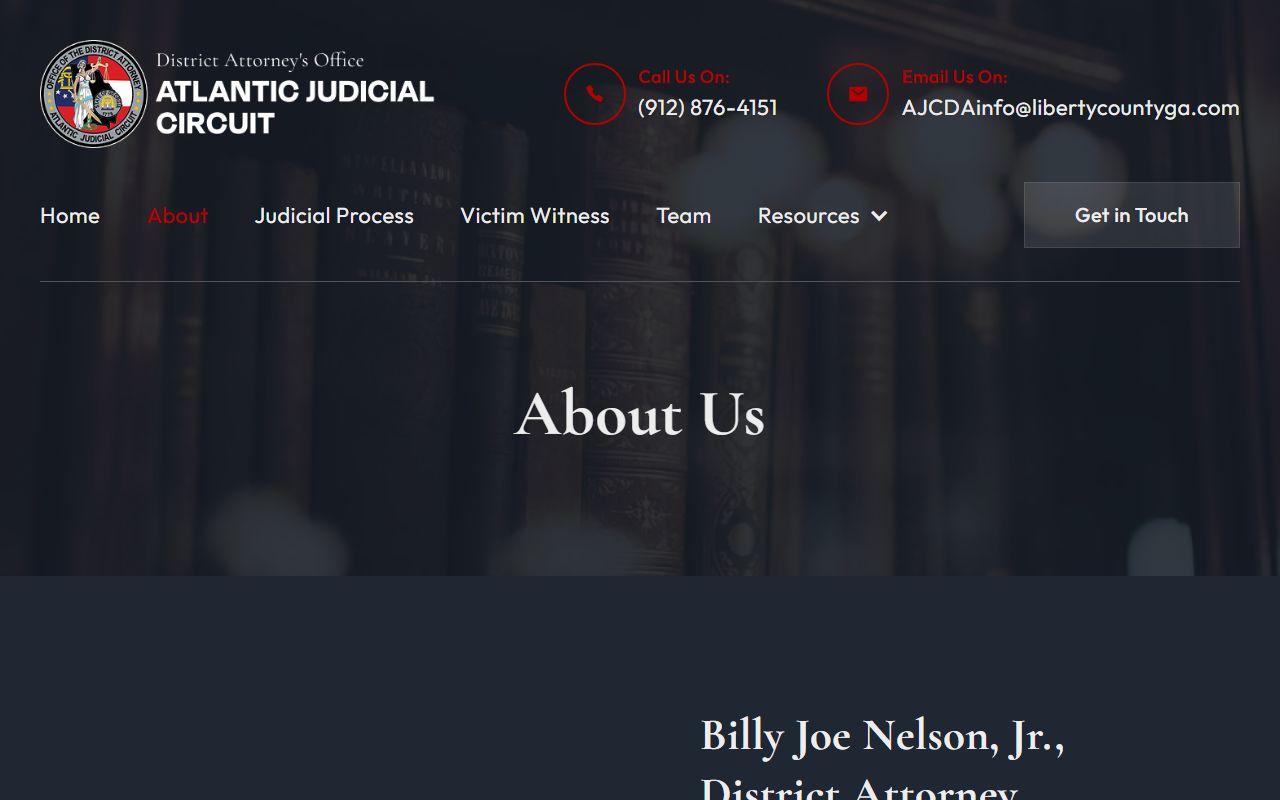
That official biography helps identify the current felony prosecutor, but case outcomes still come from court records and certified clerk dispositions.
The public defender route is separate. The Georgia Public Defender Council describes circuit public defenders and local offices that represent people who cannot afford counsel. The Clerk directory lists Public Defender Liberty County at 912-369-6338.

Defense representation affects motions, pleas, hearings, and trial records, but the Clerk remains the court-file custodian.
Liberty County Charges vs Convictions
A charge is an allegation filed into the criminal process. A conviction is an outcome after a guilty plea, verdict, or other court action that legally establishes guilt. Liberty County jail rows can show charge data, warrant numbers, counts, statutes, misdemeanor or felony indicators, court, and bond before the court reaches final disposition. That early information is useful, but it is not the same thing as a conviction.
| Charge | Conviction | |
|---|---|---|
| Meaning | An accusation that a person violated a criminal law. | A final court outcome establishing guilt by plea or verdict. |
| Where it may appear | Jail roster, warrant, accusation, indictment, arraignment, or docket entry. | Certified disposition, judgment, sentence sheet, or final criminal case record. |
| Can it change | Yes. It may be amended, reduced, dismissed, no-billed, or not prosecuted. | Changes require later court action, appeal, restriction, or other lawful process. |
| Best proof | Charging document or current court docket. | Certified disposition from the Clerk of Courts. |
For a closer look at filed charges and arrest-to-court charge movement, use the Liberty County court charge records page; for full criminal case outcomes, stay with the criminal court record and certified disposition.
Reading Criminal Dispositions
Disposition means outcome. In Liberty County criminal court records, a disposition can show whether a charge ended by guilty plea, trial verdict, dismissal, no bill, non-prosecution, or another court action. Sentencing is related but different. A sentence explains the penalty or terms after a conviction or plea, such as jail, probation, fines, costs, restitution, or other conditions.
The safest reading method is to compare the charge, court, hearing sequence, plea or trial result, and final disposition. A person may have several counts in one case. Some counts may resolve differently from others. A bond order or calendar setting does not prove final outcome. When a school, licensing agency, employer, immigration matter, or court proceeding requires official proof, request a certified criminal disposition from Clerk Linda Dixon Thompson's office at the Liberty County Justice Center.
Note: The Clerk provides specific criminal dispositions, but does not run broad criminal-history searches for the public.
Sealed and Restricted Criminal Records
Georgia criminal-record access uses both court sealing concepts and criminal-history record restriction. A sealed court record is hidden from public court-file access by statute or court order. Record restriction limits public dissemination of eligible criminal-history information through the Georgia process, and the Clerk form index links separate GCIC/GBI forms for arrests before July 1, 2013 and arrests after July 1, 2013. Georgia commonly uses "restriction" instead of everyday "expungement" language.
| Sealed Court Record | Restricted Criminal-History Record | |
|---|---|---|
| Main effect | Limits public access to a court file or part of a file. | Limits public dissemination of eligible arrest or criminal-history information. |
| Source | Statute, court rule, or court order, including access limits under court-record rules. | Georgia record-restriction process, including GCIC/GBI forms and required routing. |
| Common need | Protect juvenile, sealed, adoption, health, minor, or personal identifier material. | Address eligible dismissed, no-billed, not prosecuted, or qualifying arrest outcomes. |
| Custodian issue | The Clerk controls court records for Superior, State, Juvenile, and Magistrate matters. | The Clerk, Sheriff's Office, prosecutor, court, and GBI/GCIC may each control different records. |
Juvenile criminal-type matters are not ordinary public files. Liberty County's court-history and calendar material both say juvenile files are confidential and cannot be shown on the public TBO scheduled-case list. Personal identifiers, financial account numbers, protected addresses, adoption material, and health-related information may also be redacted or withheld.
Access to Liberty County Criminal Records
Public access to Liberty County criminal court records comes from both Georgia public-record law and court-record rules. The Attorney General's Georgia open government law page identifies the Georgia Open Records Act, including O.C.G.A. 50-18-70, 50-18-71, and 50-18-72. Those provisions support inspection and copying while allowing lawful fees, redaction, and exemptions. For court files, Uniform Superior Court Rule 21 recognizes public court-file access unless limited by law or court order.
The Liberty County directory entry for the District Attorney, Atlantic Judicial Circuit gives the local felony prosecution office contact details.
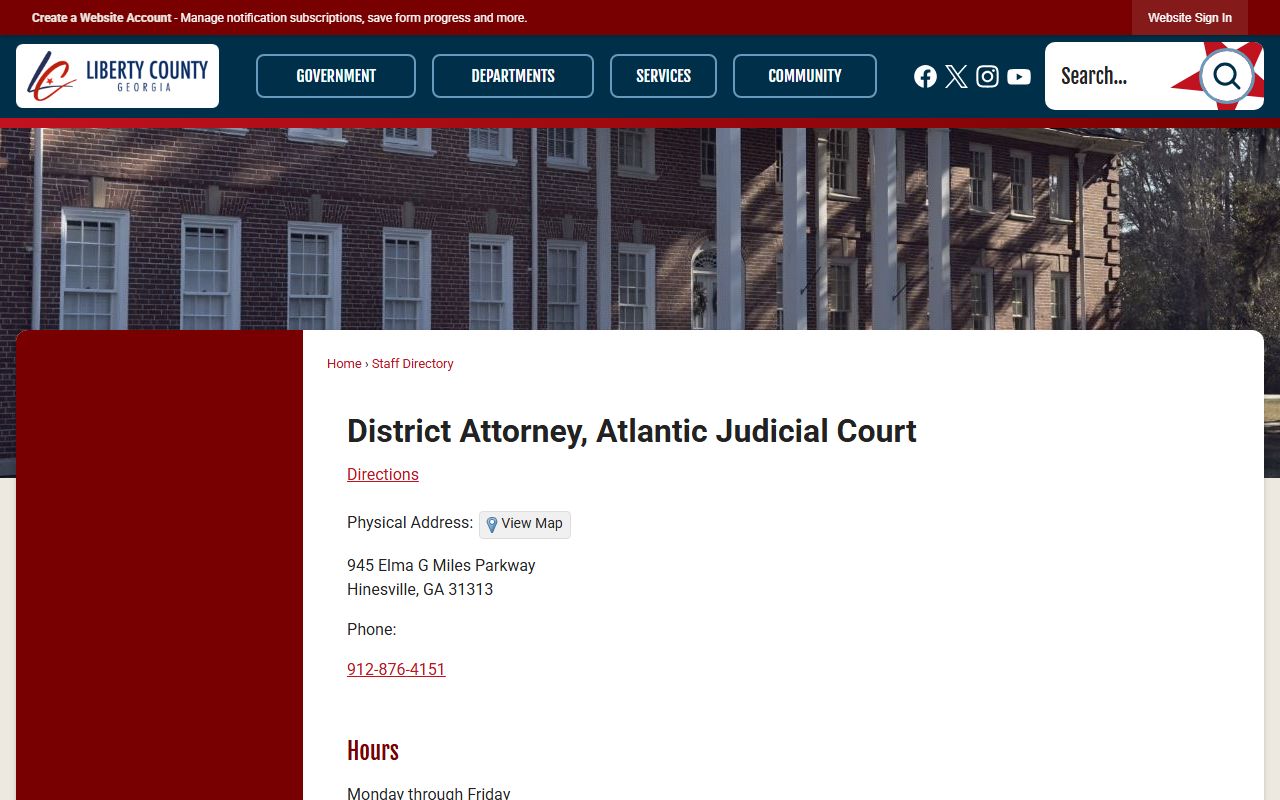
Prosecution offices can explain their own role, but filed criminal court records, certified copies, and dispositions route through the Clerk of Courts.
Important: Public case lookup is not a consumer report, and official criminal-history checks use the proper government channel.
Certified Liberty County Criminal Records
Certified criminal dispositions and court-file copies come from the Clerk of Courts when the record belongs to Superior, State, Juvenile, or Magistrate Court. Provide the case number if known, defendant name, court, charge or disposition sought, and the document type. If the online portal is missing an older record or image, call the Clerk rather than assuming no record exists. Copy, certification, and administrative time charges may apply when requests exceed ordinary inspection time.
Liberty County Clerk of Courts
201 South Main Street, Suite 1200
Hinesville, GA 31313
912-876-3625
Criminal dispositions, case files, public terminals, and certified copies
For statewide criminal-history information, use the Georgia criminal-history process rather than asking the Clerk to search every possible name match. For state-prison offender information after sentencing, the Georgia Department of Corrections offender search is separate from county court records and county jail data.