
Liberty County Arrest Records and Charges
Liberty County arrest records begin on the law-enforcement and jail side of the process. The Liberty County Sheriff's Office inmate information page links the public jail roster, and the roster shows booking-centered fields such as name, status, arrest date, arresting agency, days in jail, total bond, warrant number, count, statute, charge description, misdemeanor or felony level, and court. Those details are useful for seeing what charge labels were attached at booking, but they are not the final court record.
Court charge records begin when a prosecutor or court process turns the arrest into a formal accusation, indictment, traffic accusation, probation matter, or other charging document. Liberty County uses the CM Web Search portal for public case lookup in Clerk-held court records, while the jail roster remains the best official public source for recent custody rows. Booking details belong with the Liberty County inmate records workflow; the full plea, sentence, and disposition belong with Liberty County criminal court records.
The 24 Hours Arrests roster is a direct source for recent booking activity.
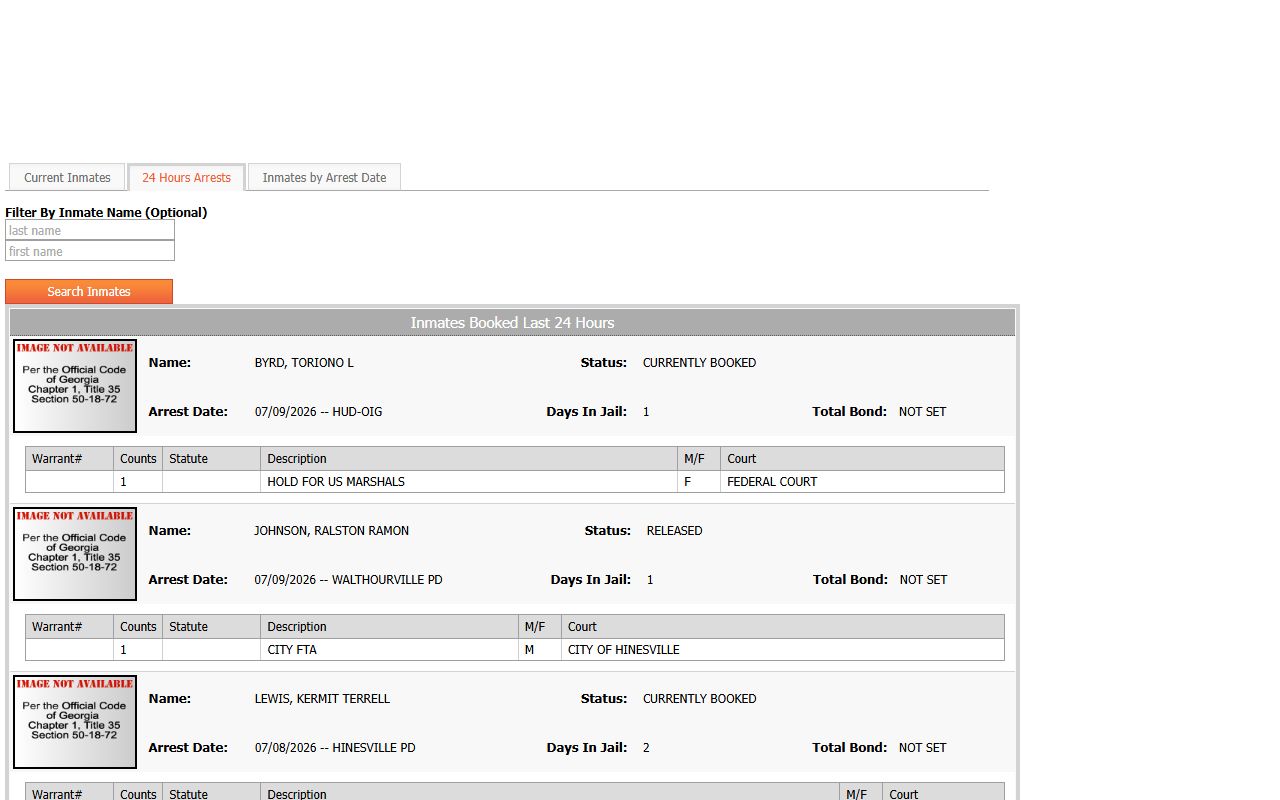
Use the roster as an early charge and booking snapshot, then confirm the filed case and disposition through the Clerk or the court handling the matter.
Liberty County Court Charges After Arrest
Liberty County criminal matters can begin in more than one court. Magistrate Court handles arrest warrants, search warrants, preliminary hearings, and bond hearings. State Court handles misdemeanors and traffic cases. Superior Court handles felony matters and major criminal case stages. The Liberty County Clerk of Courts is the custodian for Superior, State, Juvenile, and Magistrate court records, but the Clerk's criminal-history policy says the office does not conduct broad misdemeanor or felony background searches.
The Atlantic Judicial Circuit District Attorney prosecutes felony matters for Bryan, Evans, Liberty, Long, McIntosh, and Tattnall counties. District Attorney Billy Joe Nelson Jr. leads that office. After arrest, felony charges may move from booking and Magistrate proceedings into DA review, grand-jury action, arraignment, plea or motion calendars, trial, and sentencing in Superior Court. Misdemeanor cases and many traffic-criminal charges generally proceed in State Court through the solicitor.
| Charging path | Liberty County use | Record source |
|---|---|---|
| Booking charge | Initial charge label shown after arrest | Jail roster and 24-hour arrests |
| Magistrate warrant or bond matter | Arrest warrant, bond hearing, preliminary hearing | Magistrate Court and Clerk records |
| State Court accusation | Misdemeanor and traffic-criminal prosecution | CM Web Search, Clerk, State Court calendars |
| Superior Court indictment or accusation | Felony case after DA or grand-jury action | CM Web Search, Clerk, Superior Court calendars |
Search Liberty County Arrest Records
A practical Liberty County arrest records search starts with the most recent public source and then moves to the case system. The jail roster can show a current or recent booking before the formal court file has enough detail to answer the outcome question. CM Web Search is stronger when a case number, defendant name, or filed court charge is already known.
- Open the 24 Hours Arrests roster for recent booking rows, or use the current jail roster for people still in custody.
- Read the charge row carefully. Match the name, status, arrest date, court, warrant number, statute, and description before assuming a booking row belongs to the correct person.
- Search Liberty County CM Web Search by party, associated party, or case number when the court case has been filed.
- For certified proof of disposition, contact the Clerk criminal-history request channel for a specific disposition rather than a broad background search.
The Georgia offender search guide explains that state offender lookup is different from a county jail search.
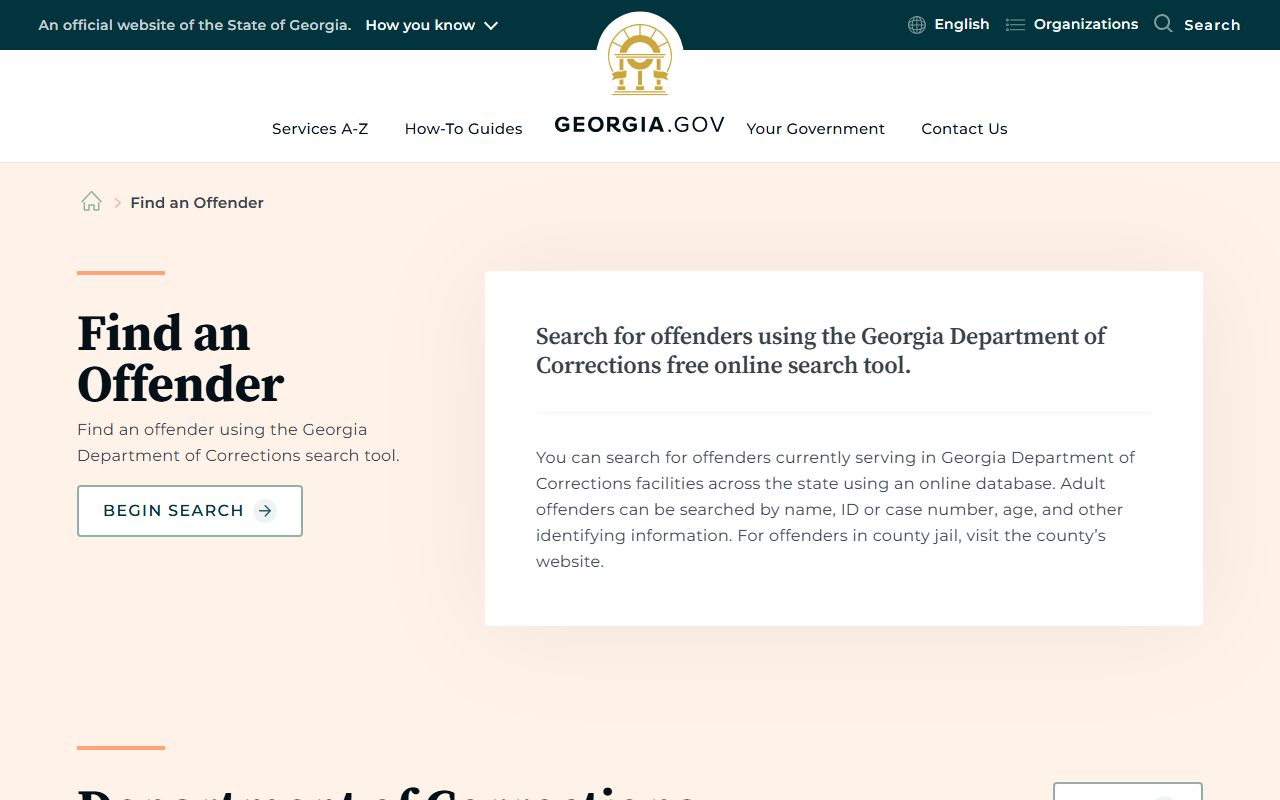
That state guide is useful when the person may be in state prison, on probation, or on parole, but Liberty County booking and pending local charge checks still start with county sources.
Liberty County Charge Documents
Charge records use terms that can sound alike. A complaint or warrant-related paper may be tied to the earliest stage. An accusation is commonly a prosecutor-filed charge document, often in misdemeanor practice and some felony procedures. An indictment is a grand-jury charging document. Liberty County research confirms that the District Attorney is legal advisor to the grand jury in felony matters, and the grand jury returns true bills or no bills on indictments.
| Complaint | Accusation | Indictment | |
|---|---|---|---|
| Filed or initiated by | Officer, court, or prosecutor process | Prosecutor | Grand jury |
| Common local use | Early warrant, bond, or misdemeanor stage | State Court and some criminal filings | Felony Superior Court matters |
| Reader should check | Warrant number, charge, bond, court | Case number, count, statute, status | True bill, count, arraignment, disposition |
One arrest can produce several counts. The roster examples captured during research included DUI, failure to maintain lane, probation violation, reckless driving, driving without a valid license, family-violence battery, and cruelty to children. Courts shown included State Court, Superior Court, Federal Court, and City of Hinesville, so venue matters as much as the charge label.
Liberty County Charge Status
Charge status can change as the case moves. A booking charge may be replaced by a filed accusation or indictment. A count may be amended, reduced, dismissed, no-billed, or marked nolle prosequi, a term for a prosecutor's decision not to pursue the charge. The public should not treat a charge label as a final court result unless the disposition confirms it.
| Status | What it means |
|---|---|
| Pending | The charge has not reached a final plea, verdict, dismissal, or other disposition. |
| Amended or reduced | The charge was changed, often to a different statute, count, or severity level. |
| Dismissed | The court record shows the charge was ended without conviction on that count. |
| Nolle prosequi | The prosecutor chose not to continue prosecution of that charge. |
| Convicted | A guilty plea, bench finding, or jury verdict produced a conviction on that count. |
Note: Liberty County Clerk staff can provide specific dispositions, but the office does not run broad criminal-history searches.
Liberty County Charges vs Convictions
A charge is an accusation. A conviction is an outcome. Liberty County court records may show both, but each has a different meaning. A defendant may have several charges from one arrest, and only some may end in conviction. Other charges may be reduced, dismissed, or restricted from public criminal-history release if Georgia law allows.
| Charge | Conviction | |
|---|---|---|
| Stage | Filed accusation, indictment, or count | Final plea, verdict, or finding |
| Proof level | Based on probable cause or filed prosecution | Based on guilty plea or proof beyond a reasonable doubt |
| Record reading | Check status and disposition before relying on it | Check sentence, probation, fines, and appeal history |
Sealed and restricted records also differ. Georgia commonly uses record restriction for eligible criminal-history access limits, and Liberty's Clerk form index links separate GCIC/GBI forms for arrests before and after July 1, 2013.
| Sealed or limited court access | Georgia record restriction | |
|---|---|---|
| Public visibility | Hidden or limited by law or court order | Restricted from eligible public criminal-history dissemination |
| Common triggers | Juvenile files, sealed orders, protected data | Eligible dismissed, no-billed, or non-prosecuted arrests |
| Local step | Ask the court custodian about access limits | Get exact arrest, charge, agency, court, and disposition information |
Georgia Charge History Lookups
Statewide criminal-history and offender searches are not the same as Liberty County arrest records. The Georgia Department of Corrections offender search covers sentenced state offenders, probation, or parole data. The GBI and GCIC ecosystem handles statewide criminal-history dissemination and record restriction. For a current Liberty County jail stay, Georgia.gov tells users to check county websites rather than the state prison search.
The Georgia Department of Corrections offender search form is the official state offender lookup.
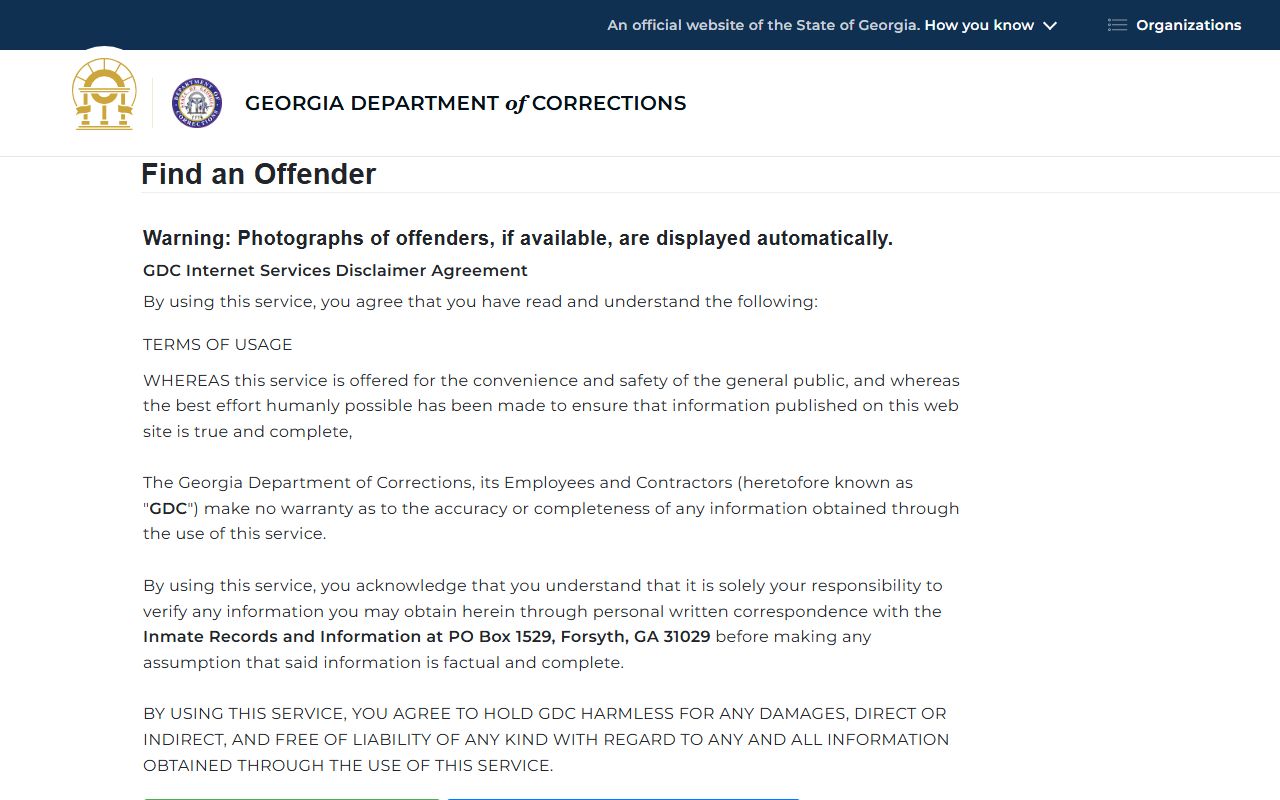
Use GDC for state-supervision questions, CM Web Search for filed Liberty County case records, and Sheriff channels for booking, incident, jail, or warrant-related records that do not appear in court search.
Restricted Liberty County Charge Records
Not every charge-related record is open to the public. Juvenile hearings and juvenile files are confidential in Liberty County. Adoption records are not ordinary public court records. Court rules and open-records exemptions protect Social Security numbers, financial account data, minor information, protected addresses, medical details, and some investigation material. A public case result may show basic docket events while sensitive filings are redacted or unavailable.
Georgia's public-record framework starts from access under the Open Records Act, but exemptions and court rules matter. Uniform Superior Court Rule 21 supports public court-file access unless a law or court order limits it. O.C.G.A. 35-3-37 is the record-restriction framework noted in the research through Clerk-linked GCIC/GBI forms. If a charge was dismissed, no-billed, not prosecuted, or otherwise eligible, the user should follow the proper agency, prosecutor, and court routing.
Important: Public charge lookups are not FCRA-regulated background checks and should not be used for employment, tenant, credit, or insurance screening.